
Art in times of hyperpolitics
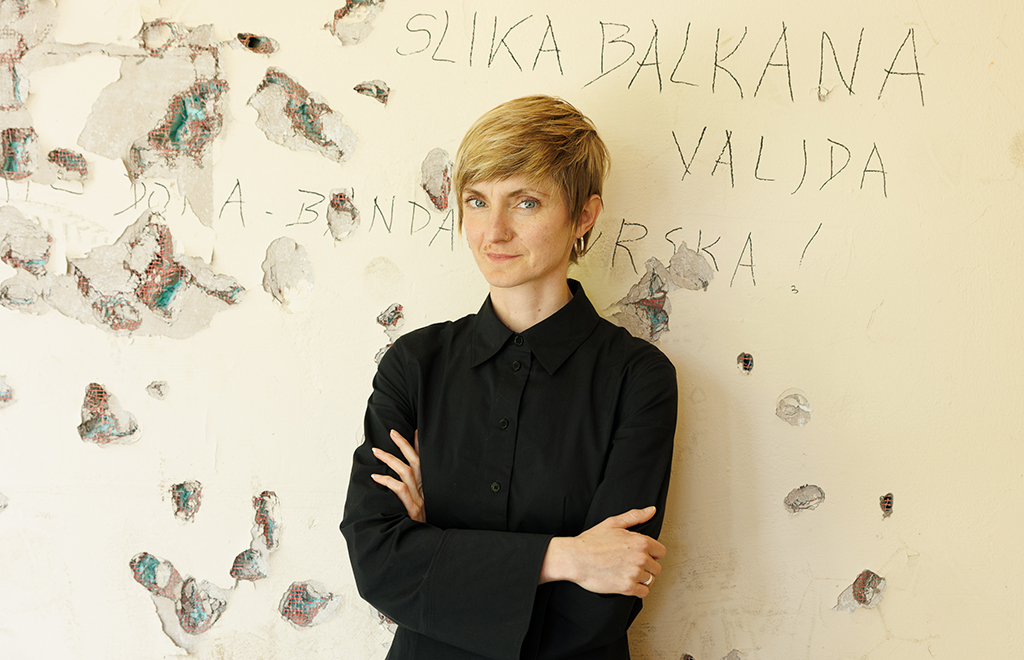
Ana Schnabl (b. 1985) is a Slovenian writer. She occasionally writes for Slovenian media outlets and is a columnist for the Guardian. Her collection of short stories Razvezani (Beletrina, 2017) met with critical acclaim and won the Best Debut Award at the Slovenian Book Fair, followed by the Edo Budiša Award in Croatia; the collection has been translated into German and Serbian. Three years later Schnabl published her first novel Masterpiece (Mojstrovina, Beletrina, 2020). She toured Europe with the English, German and Serbian translations of the book, which included a residence in the Museumsquartier in Vienna, the Literarisches Colloquium Berlin, and the first European Writer’s Festival in London. The novel was given favourable reviews and mentions in numerous Austrian, German and English media, and was longlisted for the Dublin Literary Award. Her second novel Flood Tide (Plima, Beletrina, 2022) was nominated for the Slovenian Kresnik Award. Her third novel September (Beletrina, 2024) won the Kresnik Award in 2025.
What can arts and politics do together? Where does Europe live, and where is Europe felt? Can we bridge the local and the European levels through arts and politics dialogue? What is the role of networks? And how can we reach citizens who do not often feel Europe in their daily lives? How can we rebuild trust in politicians, and how can politicians help civil society rebuild that trust? How can we all – artists, festival makers, cultural professionals, and politicians from local to European level – have a horizontal conversation? Can we create a symphony with those thoughts and ideas? How could this symphony be translated into policies? And can policies then offer opportunities for more symphonies to be composed? How can we bring artists and politics to the human level and bridge the distance that different kinds of intellectuality create?
We live in an age in which everything appears political. Every image, statement, silence, aesthetic preference, institutional decision, celebrity gesture, museum acquisition, and algorithmic recommendation can become the object of political interpretation. Yet at the same time many people experience a profound sense of political powerlessness. Politics seems omnipresent, while meaningful political consequence often appears absent.
This paradox lies at the heart of the concept of hyperpolitics, developed by the political theorist Anton Jäger in his book Hyperpolitics: Extreme Politicisation without Political Consequences. Jäger describes a condition in which society is saturated with political intensity, moral urgency, and symbolic conflict, yet increasingly detached from the durable institutions and collective structures capable of producing lasting social transformation.
What does this condition mean for art? Not simply for “political art,” but for art as such: its role, its burdens, its possibilities, and perhaps even its forms of resistance in a hyperpolitical age.
The age of hyperpolitics
Jäger’s central insight is deceptively simple. Throughout much of the twentieth century, politics was organised through institutions: political parties, trade unions, civic associations, churches, newspapers, neighborhoods, and ideological movements. Political life was not necessarily more democratic or more just, but it possessed a degree of structure and continuity. Political engagement unfolded over time and generated organisational forms that could accumulate power and sustain collective action.
Today, political expression has become diffuse, permanent, and increasingly personalised. Politics migrates into lifestyle, consumption, identity, culture, and online performance. Political energy circulates continuously, but often without institutional sedimentation. Outrage erupts and dissipates. Movements emerge with extraordinary visibility and disappear just as rapidly. Public attention moves from one moral emergency to another with little temporal distance between them.
Hyperpolitics is not a condition of depoliticisation. On the contrary, it is a condition of over-politicisation without strategic accumulation. It is, in Jäger’s formulation, “extreme politicisation without political consequences.”
Few spheres reveal this dynamic more clearly than contemporary art.
The hyperpoliticisation of art
Art today exists under conditions of continuous interpretation. Every work arrives already embedded within a framework of ideological anticipation. Before audiences encounter an artwork on its own terms, a series of questions often precedes the experience.
What position does it take? Who is represented? Who has the right to produce it? Is it complicit? Ethical? Harmful? Radical enough? Insufficiently radical? Does it challenge power or merely aestheticise it?
This atmosphere has transformed not only criticism but artistic production itself. Artists increasingly work under the pressure of anticipated judgment. Institutions curate under conditions of reputational anxiety. Audiences consume culture through frameworks of political legibility.
Many of these developments emerged from legitimate historical demands. Critics and activists called on museums to confront colonial legacies, on cinema to address race and gender differently, and on cultural institutions to abandon the fiction that aesthetics exist outside history. These interventions were necessary and remain important.
Yet hyperpolitics introduces a subtle shift. The question is no longer whether art is political. That debate has largely been settled. The more pressing question is whether art can survive the demand for immediate political transparency. Can art remain ambiguous? Can it hesitate? Can it resist declaring its meaning instantaneously? Or must every artwork become a position paper?
The collapse of distance
One of the defining characteristics of hyperpolitics is the collapse of distance between aesthetics and reaction.
Historically, works of art entered relatively slow circuits of interpretation. Novels, films, and paintings often acquired political meanings gradually, over years or even generations. Interpretation unfolded through extended conversations and changing historical contexts.
Today, interpretation is immediate. An artwork appears online and instantly enters the economy of commentary. Reactions often precede encounters. The politicisation of the work is no longer a secondary process; it increasingly becomes the primary mode of experience.
This produces a peculiar compression of time. Art is consumed less as an experience than as evidence: evidence of morality, ideology, identity, or belonging. Social media platforms accelerate this tendency because they reward moral clarity, emotional intensity, and conflict. Ambivalence performs poorly in algorithmic environments.
Yet ambivalence has always been one of art’s most valuable resources.
The fate of ambiguity
Many of the most significant modern artists and writers mattered precisely because they resisted clarity. Chinua Achebe offered no ideological instruction manual. Samuel Beckett provided no actionable optimism. Rachel Cusk refuses to simplify moral contradiction. Their works created spaces of uncertainty and interpretation.
Hyperpolitics, however, often mistrusts uncertainty. Ambiguity is treated as evasion. Complexity becomes suspicious. Irony appears dangerous. Distance is interpreted as privilege.
Artists consequently face a difficult dilemma. If they refuse the demands of political immediacy, they risk irrelevance. If they fully submit to them, they risk becoming reducible to messaging. Art becomes trapped between propaganda and irrelevance.
This tension has become one of the defining conditions of contemporary cultural production.
Visibility and the politics of performance
Hyperpolitics also transforms politics into a question of visibility. Increasingly, to be political means to display one’s political consciousness publicly. Visibility becomes a form of virtue.
As a result, contemporary politics often appears aesthetic before it appears strategic. It becomes performative, semiotic, and theatrical. In this respect, Jäger’s analysis echoes earlier critiques such as those of Guy Debord, who argued that modern life increasingly unfolds through spectacle and representation.
The difference today is that spectacle is no longer centralised. It has been decentralised across countless digital platforms and self-curated performances. Everyone becomes both spectator and broadcaster.
Art occupies an unstable position within this environment. Museums become stages for ethical signaling. Artists become symbolic representatives of political causes. Cultural institutions compete to demonstrate awareness and responsiveness.
Yet awareness itself can become detached from transformation. Symbolic circulation proliferates while institutional change remains limited. Once again, we encounter the defining paradox of hyperpolitics: intense politicisation without durable consequence.
Exhaustion and interpretation
Many artists describe a distinctive form of exhaustion. Beyond economic precarity, they experience interpretive fatigue. Every work seems burdened with impossible moral expectations.
Artists are no longer expected merely to create. They are expected simultaneously to educate, represent, heal, intervene, and anticipate controversy. Because digital discourse never truly concludes, no artwork is ever finished being interpreted. The machinery of commentary remains permanently active.
This creates a climate of anticipatory defensiveness. Artists self-censor. Institutions overcorrect. Audiences arrive prepared to judge rather than encounter.
The result is not censorship in the classical authoritarian sense. It is something subtler: a diminished tolerance for opacity.
Art and politics: An old relationship
None of this implies that art was ever separate from politics. Renaissance art was political. Religious art was political. Nationalist art was political. Avant-garde art was political. Even the modern ideal of artistic autonomy emerged under specific historical and political conditions.
The issue, therefore, is not whether art and politics should be separated. The issue is what kind of political relationship art should maintain with society.
Hyperpolitics generates a specific pathology by collapsing politics into a state of continuous moral immediacy. Under such conditions, art risks losing the temporal difference that distinguishes it from everyday discourse.
That difference matters. Art often operates indirectly. It produces estrangement, delay, reflection, disorientation, and silence. These are not apolitical experiences. They may be political precisely because they interrupt the compulsive immediacy that characterises hyperpolitical life.
The politics of slowness
Perhaps one of the most radical things art can do today is slow perception down.
We inhabit a culture of accelerated reaction. News cycles move rapidly. Social media feeds move rapidly. Outrage moves rapidly. Art remains one of the few domains that can resist this acceleration.
A novel still asks for hours of attention. A film still demands duration. A painting still requires sustained looking.
This is not a nostalgic defense of a pre-digital world. Digital culture is not disappearing. But art can create pockets of temporal resistance within accelerated environments.
Such resistance may possess political significance that is not yet fully understood. Democracy requires temporal depth. Thinking requires duration. Collective life requires patience. Solidarity requires continuity.
Hyperpolitics fragments all three.
Beyond cynicism
There is, however, a danger in overdiagnosing hyperpolitics. Critique can easily slide into cynicism. One might begin to believe that all activism is merely performance, that all political culture is spectacle, or that moral language is nothing more than branding.
Such conclusions would be mistaken.
People mobilise because real injustices exist. They politicise culture because culture matters. The anger that animates contemporary movements is often genuine and justified. The problem is not that politics contains too much emotion. The problem is that emotional intensity alone cannot substitute for organisation, continuity, or collective structure.
Art cannot solve this crisis. But it can illuminate it.
Some of the most compelling contemporary artworks do not offer solutions. Instead, they reveal the emotional and psychological texture of hyperpolitical life: exhaustion, fragmentation, permanent visibility, and the loneliness concealed beneath continuous connection.
They make our condition perceptible. And perception is not a trivial achievement.
Defending complexity
What, then, should art do?
The answer is not a return to some mythical notion of “pure art.” Nor is it a demand for ever greater political functionality.
A more productive response may be to defend art’s right to complexity: its right to ambiguity, contradiction, slowness, and unresolved meaning.
In a hyperpolitical age, ambiguity itself can become a form of resistance. Not because ambiguity is inherently virtuous, but because contemporary media environments reward instant moral simplification.
Art reminds us that human experience exceeds simplification. It exceeds slogans, categories, and declarations of certainty.
Perhaps this is one reason why authoritarian movements so often mistrust serious art. Serious art destabilises certainty. It complicates the narratives upon which ideological authority depends.
Attention as resistance
Hyperpolitics creates a peculiar sensation of permanent emergency. Everything feels urgent, charged, and symbolic. Yet many people simultaneously experience paralysis and disempowerment.
Art cannot repair political institutions. It cannot replace collective organisation. It cannot single-handedly overcome the fractures of contemporary life.
What it can do is preserve forms of attention that hyperpolitics steadily erodes: attention to ambiguity, duration, silence, complexity, and to what cannot be reduced to immediate visibility.
This may be one of art’s most important tasks today – not to escape politics, but to resist becoming entirely absorbed by the hyperpolitical machinery of instantaneous reaction.
Art can create spaces in which experience becomes thinkable again. Spaces in which we are not only reacting, but perceiving; not only signaling, but reflecting; not only consuming politics aesthetically, but imagining forms of life beyond permanent spectacle.
In this sense, art remains political not despite its ambiguity, but because of it..
This text is based on the opening keynote of Ana Schnabl at the European Festivals Association’s Arts Festivals Summit on 18 May 2026 in Budva, Montenegro, hosted by Theatre City Budva.
Festival Life creates shared moments of audiences and artists, eye-to-eye